--------------
bodhisattva, in Buddhism, one who seeks awakening (bodhi)—hence, an individual on the path to becoming a buddha.
-------------
In the strict sense of the definition above you have probably encountered a bodhisattva already. You probably did not notice overly and perhaps thought them mild and inconspicuous. You may or may not have been pleasant to them.
Bodhisattva in this sense is an all-encompassing term and can stretch from one newly seeking up to a high degree bodhisattva who quite literally decides to put off his or her liberation at the point where they might find release in order to aid all sentient beings. These are probably significantly rarer.
I am not aware of any spreadsheet or pie chart explaining the conversion rate of entry level bodhisattvas. There is no Ofsted report on efficacy of enlightenment. People don’t gather around in committees to make 2026 Bodhisattva Excellence Framework (BEF) reports and decisions.
It is safe to speculate that the entire orientation of a genuine bodhisattva might differ markedly from a common or garden human being. To the extent that a “normal” person may not be able to comprehend nor get “where they are coming from”. Often we are only able to perceive and assimilate that which is similar to us and close to that which we have already assimilated. Anything which differs too markedly is a DNC, a does not compute.
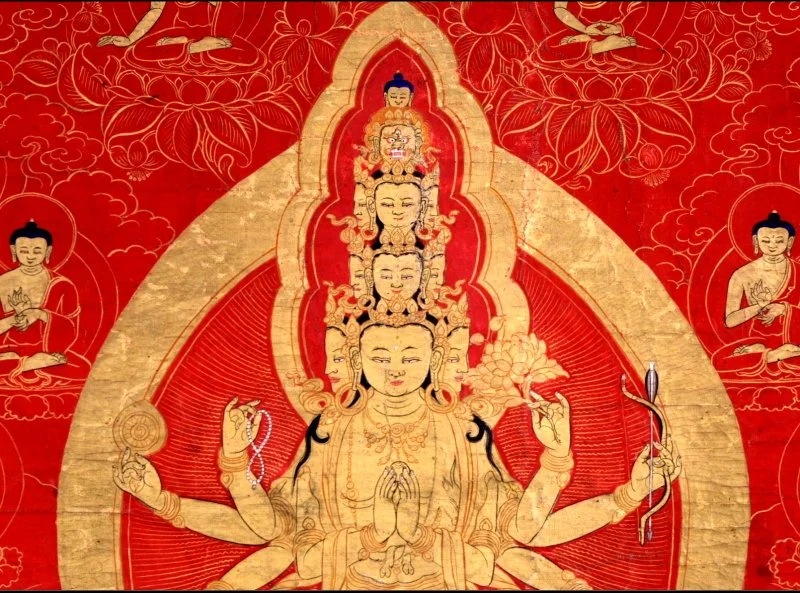
In scientific iconography we might have Einstein, Heisenberg and Turing. In the bodhisattva family we might have Manjushri and Avalokiteshvara. Depiction of the latter dates back to the 11th century {post thumbnail} and beyond and the 17th century below. Just because we ourselves don’t share the iconography it does not mean that is not significant in the hearts and minds of others.
------------
--
-
Avalokiteshvara supremely exemplifies the bodhisattva’s resolve to postpone his own Buddha-hood until he has helped every sentient being on earth achieve liberation (moksha; literally, “release”) from suffering (dukkha) and the process of death and rebirth (samsara). His name has been variously interpreted as “the lord who looks in every direction” and “the lord of what we see” (that is, the actual created world).
----------------------
To pooh-pooh something about which we know little is common. I spent more than a decade looking in to science and in that time I read and understood some pretty esoteric stuff. I have also looked into Buddhist literature probably more than most.
In this it is very bad karma to diss and otherwise treat badly a bodhisattva. The more “evolved” such a being might be the worse the karma for the transgressor. There is no way of proving this statement. It sounds a bit like PR. In this literature it is very unlikely that a bodhisattva would think of anyone as an enemy. However people might construe and deem a bodhisattva an enemy, their enemy. They may seek to belittle and destroy him.
In bodhisattva world all are sentient beings caught suffering upon the wheel of rebirth. The word enemy is not in a bodhisattva’s dictionary of thought. It is a DNC.
People who demarcate the world into foes and friends, allies and enemies, pal or nemesis, see the world in one way. If one sees only opponents to be beaten and ground into the dust so that one can claim a victorious triumph. Wanting to win and have victory over another being and to subjugate them is not bodhisattva thinking.
There is an outside chance that ego rules in a house such as that.
One could say that art and literature in general has little to depict and show about bodhisattva thinking. It is not good box office as there is not enough greed sex and violence.
Being emotionally still and detached does not generate millions of hits and follows on the internet. It is too boring for most.
Dramatic soap opera excites…this is the world of entertainment and acquisitional conspicuous competitive hedonism, the world of show and tell, the world of comparison.
Perhaps this is where true liberation can be found?
Perhaps all bodhisattvas are badly mistaken and wasting their lives?